Laura Vilar Planella, Ignacio Rodríguez García, Ramon Rovira Negre, Tomás Cortadellas Rosel, Pere N. Barri-Soldevila, Silvia Franco Camps, Silvia Cabrera Díaz. J Minim Invasive Gynecol. 2026 Aug 30:S1553-4650(26)00468-1. DOI: 10.1016/j.jmig.2026.08.029
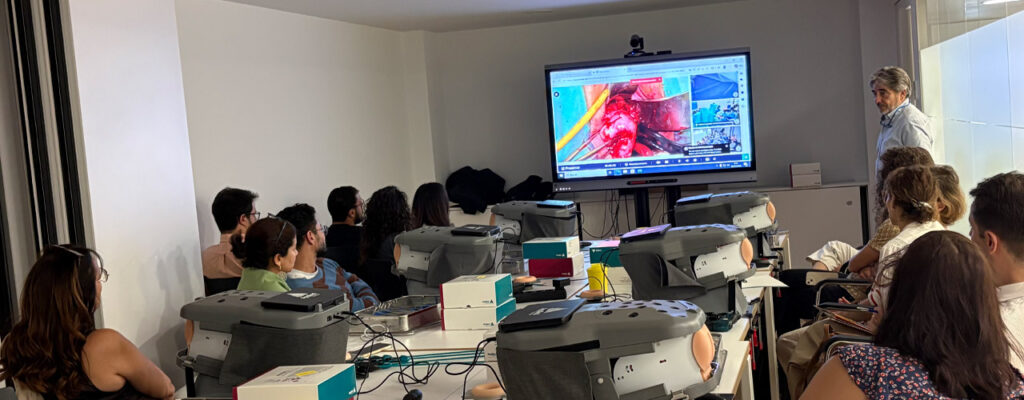
Simulation-based training improves the technical skills of professionals performing gynecological laparoscopic surgery, regardless of whether physical or virtual reality simulators are used. This is the conclusion of a systematic review and meta-analysis published in the Journal of Minimally Invasive Gynecology, led by Dr Laura Vilar Planella, a gynecologist at Dexeus Mujer. The study examines the effectiveness of both training methods and the influence of previous surgical experience on outcomes, aiming to provide scientific evidence to help optimize specialist training.
The research, conducted in accordance with PRISMA guidelines, included 16 studies involving 474 participants, ranging from individuals with no previous laparoscopic experience to medical residents and practicing gynecological surgeons. Of these, 362 used physical simulators (box trainers) and 112 used virtual reality simulators.
The results showed significant improvements in task completion time, movement precision and Objective Structured Assessment of Technical Skills (OSATS) scores, as well as in bleeding-related parameters. No statistically significant differences were found between the two types of simulators, although the available data do not establish their equivalence. Previous surgical experience influenced improvements in task completion times but did not eliminate the improvements observed in OSATS scores.
The study supports the use of simulation-based training in gynecological surgery and highlights the potential of physical simulators as a more accessible and cost-effective alternative to advanced technologies. However, the authors caution that improvements observed in simulation training do not necessarily translate into better clinical outcomes for patients.